The Enterprise Guide to Safe Customer Feedback and Data Privacy in 2026
1. The Hidden Security Loophole in Your Customer Feedback Loop
Customer feedback is the lifeblood of any growing business. In 2026, companies are hyper-focused on capturing user insights through Net Promoter Score (NPS) surveys, product feedback forms, and churn questionnaires to fuel their growth loops.
But as fast-growing teams sprint to collect this goldmine of data, they frequently stumble into a massive, hidden compliance blind spot.
We see it happen all the time: a marketing manager or product owner needs a quick survey spun up by Friday. They bypass the IT department and launch a form using a lightweight, unsecured free tool. The mindset is always the same: "It’s just a feedback survey—what’s the worst that could happen?"
The Reality Check: Your customer survey tool is often the weakest link in your corporate data security chain.
The moment a customer enters an email address, a corporate domain, or leaves an open-ended comment about their company workflows, that survey response becomes protected corporate and personal data. In the United States, mishandling this information doesn't just annoy your customers; it can trigger severe legal penalties and completely derail your B2B sales pipeline.
If you are expanding in the US market, your software stack must be ironclad. That means any tool touching customer inputs must align with two critical gold standards: SOC 2 certification and CCPA compliance.
In this guide, we will break down exactly why these frameworks matter for something as seemingly simple as a customer survey, the hidden financial risks of ignoring them, and how you can protect your business while still capturing the honest user insights you need to scale.
2. SOC 2: The Non-Negotiable Passport to the US B2B Market
If you are trying to sell to US enterprises, mid-market corporations, or even well-funded tech startups, you will quickly hit a wall called the Vendor Security Assessment. In the US business ecosystem, procurement and IT departments do not take word-of-mouth promises for data safety. They demand proof, and that proof is SOC 2.
Developed by the American Institute of Certified Public Accountants (AICPA), a SOC 2 (System and Organization Controls) report is a rigorous, independent audit. It evaluates a software vendor’s internal controls to ensure they protect data across five critical "Trust Services Criteria": Security, Availability, Processing Integrity, Confidentiality, and Privacy.
When a US enterprise reviews your software stack, a SOC 2 report isn’t a nice bonus—it is a binary filter. If a tool handles their data but lacks a SOC 2 audit, the deal is dead before it even reaches the negotiation table.
Why a "Simple" Survey Tool Triggers a SOC 2 Requirement
Many product and marketing teams are baffled when IT flags their choice of a survey tool. They think, "We are just asking clients how they like our platform."
But look closer at what a B2B customer satisfaction survey, beta-tester form, or product feedback questionnaire actually collects:
Corporate Identities: The full names, roles, and corporate email addresses of your client's key executives and employees.
Technical Infrastructure: Open-ended text fields where clients describe their tech stacks, API bottlenecks, or software bugs they are facing.
Proprietary Workflows: In-depth feedback explaining how their internal teams use your platform to generate revenue.
This isn’t trivial trivia; it is highly confidential corporate data. If a hacker intercepts this information, they gain a roadmap of your client’s internal operations, vulnerabilities, and team structures.
The Bottom Line: Using a form builder that lacks SOC 2 compliance is like meticulously building an ironclad security wall around your product, only to punch a giant hole right through the perimeter with a third-party survey plugin.
If your survey vendor doesn't undergo third-party audits to verify their encryption, vulnerability management, and employee access policies, you are actively introducing risk into your clients' ecosystems—and yours. To win and keep enterprise trust in the US, every piece of feedback must enter an audited, verified environment.
3. CCPA & CPRA: Why California’s Privacy Laws Govern Your Survey Data
While SOC 2 handles the security of business-to-business (B2B) data, consumer-facing companies (B2C) face an entirely different beast when launching surveys: The California Consumer Privacy Act (CCPA) and its recent, even stricter expansion, the California Privacy Rights Act (CPRA).
Don't let the geographic name fool you. You don't have to be headquartered in Los Angeles or San Francisco for this law to apply to you. If your business collects data from individuals residing in California—the world's 5th largest economy and a massive hub for digital consumers—and you meet specific revenue or data thresholds, you are legally bound by CCPA.
Because of California's massive market share, CCPA has effectively become the de facto national standard for consumer data privacy across the entire United States.
The Friction Point: Where Everyday Surveys Clash with Consumer Rights
Most teams view a completed customer survey as their own proprietary asset—intellectual property they can store indefinitely in their software archives. CCPA turns this concept on its head. Under this law, the data belongs to the consumer, not the company collecting it.
When you send out marketing surveys, product questionnaires, or user registration forms, two specific consumer rights under CCPA will immediately put your form builder to the test:
The Right to Delete (The "Wipe My Data" Request)
Under CCPA, a consumer can contact your company at any time and demand that you completely delete all personal information you have collected about them.
The Problem with Legacy Tools: If a customer submits a deletion request, can your team easily locate, isolate, and permanently wipe their specific survey response? If your data is trapped in disorganized legacy databases, hardcoded spreadsheets, or third-party plugins that don't support granular deletion, you are technically violating the law.
The Compliant Way: Your form infrastructure must allow you to instantly purge individual records and all associated personal identifiers across the entire platform upon request.
The Right to Know (Total Data Transparency)
Consumers have the right to know exactly what personal information a business collects about them, where that data is stored, and whether it is being sold or shared with third parties.
The Problem with Legacy Tools: Many free or cheap form builders monetize their platforms by tracking user behavior, dropping cookies, or sharing metadata with ad networks behind the scenes. If your survey tool is quietly sharing your respondents' analytical data with third parties without your explicit knowledge, your company is held legally liable for the non-disclosure.
The Warning: CCPA compliance is not a passive box you check during setup. It requires using a form platform that gives you total, transparent ownership over your data streams and the technical flexibility to honor a consumer's privacy rights instantly.
Fines, Lawsuits, and Dead Deals: The True Cost of Non-Compliance
In the fast-paced world of product development and marketing, security can sometimes feel like a bottleneck. It is tempting to think of compliance as a theoretical risk—something that only matters to Fortune 500 giants or companies that get hit by massive, international hacking syndicates.
But in the US market, federal regulators and corporate security teams have made it clear: ignorance is no longer an excuse. Treating customer data carelessly carries immediate, devastating consequences for both your bank account and your sales pipeline.
Here is what is actually on the line when you bypass compliance for your online forms.
The Financial Bleed: CCPA Statutory Fines
Many companies assume that data privacy fines are assessed as a single, flat penalty. In reality, privacy laws like the CCPA/CPRA calculate fines per individual violation (meaning, per affected user record).
Under the law, the California Attorney General can enforce penalties that escalate quickly:
Up to $2,500 for each unintentional violation.
Up to $7,500 for each intentional violation (which includes failing to fix a known security flaw after being notified).
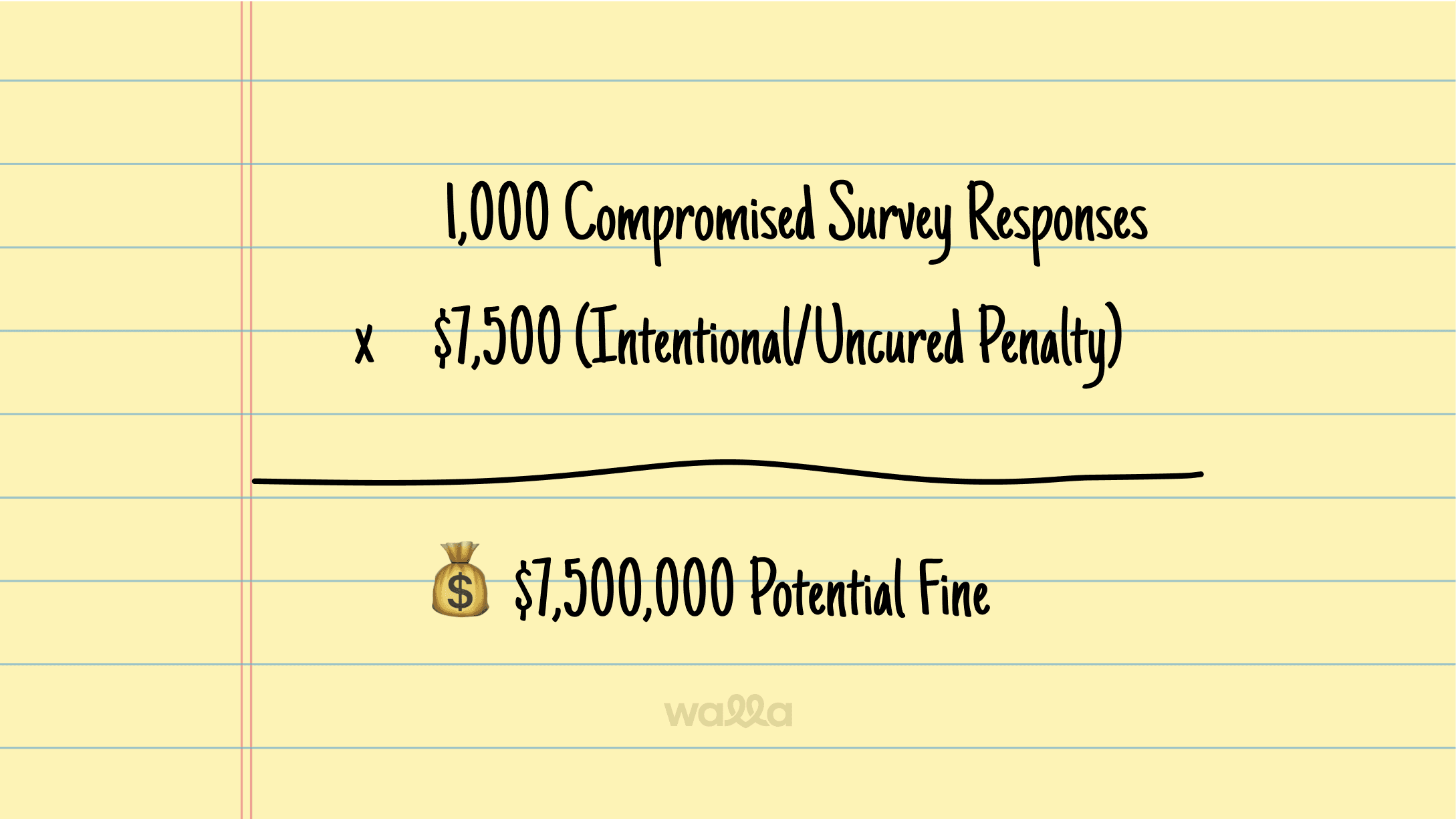
Think about it: if you run a routine marketing survey that collects feedback from 1,000 users, and your unsecured form platform leaks that data or fails to process deletion requests properly, you aren't looking at a minor slap on the wrist. You are looking at a compounding financial disaster that can easily climb into millions of dollars, not to mention the skyrocketing corporate litigation and class-action lawsuit fees required to defend your company in court.
The B2B Deal Killer: The Dreaded Vendor Security Assessment
For B2B companies, the financial damage of non-compliance isn't just about government fines—it’s about lost revenue.
Picture this: Your sales team spends six months nurturing a massive enterprise account in the US. The client loves your product, the executives are bought in, and you are ready to sign a lucrative contract worth tens of thousands of dollars.
Then, the deal hits the final hurdle: the Vendor Security Assessment.
The enterprise’s Chief Information Security Officer (CISO) sends over a 200-question security spreadsheet. They ask for your software stack, your data sub-processors, and your compliance certifications. When they discover that your product or marketing team routinely pipes customer insights, user emails, and internal feedback through an unvetted, non-SOC 2 compliant survey tool, the red flag is raised.
The Harsh Reality: To an enterprise CISO, a vendor using insecure software is a liability. Rather than risking their own ecosystem, they will walk away from the table.
In the US B2B market, failing a security review because of a casual survey tool doesn't just stall a deal—it kills it permanently, handing your hard-earned revenue directly to a compliant competitor.
5. How Walla Removes the Compliance Headache from Your Data Collection
Navigating the labyrinth of corporate security questionnaires and privacy regulations can feel like a full-time job. You shouldn't have to choose between gathering the critical user insights your product needs and keeping your legal team happy.
Walla was built from the ground up to bridge this exact gap. We provide the beautiful, high-converting survey experiences that modern teams love, backed by the uncompromised, enterprise-grade protection that CISO dashboards demand.
Here is exactly how Walla aligns your workflows with strict SOC 2 and CCPA standards without slowing down your operations.
(1) Enterprise-Grade Infrastructure Security (Built for SOC 2 Audits)
When a prospective B2B client hands you a vendor security assessment, you can confidently list Walla as a secure layer of your tech stack. Walla provides the robust security architecture required to pass the most rigorous corporate audits.
Banking-Grade Encryption: All survey data collected via Walla is encrypted using industry-standard TLS protocols while in transit, and AES-256 encryption at rest.
Immutable Audit Logs: Walla automatically generates a detailed, unalterable digital paper trail of all system activities. If a user logs in, exports a CSV, or alters a form, it is tracked with an IP address and timestamp—giving you the precise accountability needed to satisfy independent SOC 2 auditors.
(2) Absolute Data Sovereignty (Frictionless CCPA "Right to Delete" Compliance)
Honoring a consumer’s request to have their personal data wiped shouldn't require opening a ticket with your engineering team or hunting through chaotic spreadsheets. Walla gives you absolute, granular control over your data repository.
Instant Permanent Purging: If a customer invokes their CCPA "Right to be Forgotten," Walla's clean dashboard allows your administrators to search for that specific user, isolate their submissions, and permanently delete their identifiable records with a single click.
Zero Ghost Data: Once you delete a record in Walla, it is completely erased from our active databases, ensuring you remain 100% compliant with state and federal data retention boundaries.
(3) Role-Based Access Control (Adhering to CCPA Data Minimization Principles)
One of the core pillars of modern privacy laws like CCPA/CPRA is data minimization: sensitive customer information should only be accessible to employees who absolutely need it to perform their jobs. Your entire growth marketing team does not need to see a customer's specific accounting details or private system vulnerabilities just to check a satisfaction score.
PII Isolation via RBAC: Walla features advanced Role-Based Access Control (RBAC). You can lock down survey responses so that broad teams can view anonymized data trends and aggregate charts, while restricting access to Personally Identifiable Information (PII) to a select few verified security compliance officers.
Mitigating Internal Risk: By isolating data streams internally, you drastically reduce the risk of accidental insider data leaks, ensuring your user feedback loops remain secure and isolated.
6. Future-Proofing Your Feedback Loop: Security as a Growth Asset
In 2026, a customer survey is no longer just a digital sheet of paper with a few casual questions. It is a powerful, high-stakes data ingestion pipeline. As privacy regulations tighten and enterprise procurement teams become increasingly protective of their digital perimeters, treating user insights as an afterthought is a risk your business simply cannot afford to take.
To successfully win and scale in the competitive US market, data protection must be woven directly into your daily operations. Gathering honest, actionable feedback shouldn't require compromising your legal standing or risking your enterprise sales pipeline.
By building your customer feedback loops on an ironclad, compliant foundation that natively satisfies both SOC 2 and CCPA standards, you aren't just checking a bureaucratic box—you are actively turning data security into a competitive growth asset that builds deep, authentic trust with your users.
Ready to Collect Insights Without the Legal Risk?
Protect your brand, secure your pipelines, and pass every vendor assessment with flying colors using Walla’s compliance-first form builder.