Beyond Encryption: Why UI-Level Data Masking is the Ultimate Defense Against Insider Leaks
1. Protecting Sensitive PII: How Walla's Data Masking Solves Enterprise Security Headaches
The Enemy Within: The Vulnerability of Plain-Text PII
Every year, enterprise security departments spend hundreds of thousands of dollars fortifying their digital perimeters. They deploy state-of-the-art firewalls, enforce strict password rotations, and ensure that every byte of data sitting in their primary databases is encrypted to the teeth. All of this effort is spent to keep external hackers at bay.
But once that data safely passes through your secure gates and lands on your internal dashboards, a critical question remains: How are you controlling the visibility of that data when your own employees look at it?
The reality of data management is that the biggest compliance threat often isn't an external cybercriminal—it’s the unintended visibility granted inside your own organization.
When a customer submits an online form containing a Social Security Number (SSN), a direct phone number, or a billing detail, that information typically populates onto internal customer service, marketing, or operations dashboards in raw, plain text. The moment a junior developer, a customer support agent, or a third-party contractor can view unredacted Personally Identifiable Information (PII) on their monitors, your organization faces an immediate liability.
Consider the everyday scenarios where data silently leaks:
An account manager accidentally broadcasts a dashboard containing hundreds of customer profiles during a routine Zoom screen-share with a client.
A well-meaning support representative downloads an unencrypted Excel file of form responses onto their local machine to build a quick report, leaving a permanent trail of PII on a personal laptop.
A compromised or disgruntled internal employee copies customer phone numbers and identifiers directly off their screen.
The Missing Piece: Visibility Control in 2026
In 2026, simply telling regulators that your database is encrypted is no longer enough to satisfy modern security frameworks. The true battleground for enterprise data privacy has shifted to Visibility Control—ensuring that data is only exposed to those who absolutely need to see it to perform their immediate tasks.
In this article, we will explore why front-end data redaction is the most critical blind spot in current enterprise software architectures, and how Walla’s native, Automated Data Masking completely eliminates this high-stakes headache by securing data right at the user-interface level.
2. The Frontend Blindspot: Why Database Encryption is No Longer Enough
Walk into any corporate security presentation, and you will hear the same reassuring phrase: "Don’t worry, our data is encrypted at rest." Nearly every modern online form builder boasts banking-grade encryption, giving compliance teams a false sense of absolute security.
But here is the catch: encryption at rest only protects your data while it is sleeping on a server hard drive in a remote data center. It defends against an external attacker breaking into a physical server rack.
The real vulnerability occurs when the data wakes up.
The exact moment an authorized employee opens their administrative dashboard or clicks "Export to CSV," the form builder does exactly what it was programmed to do—it decrypts the data. Instantly, that highly protected, heavily encrypted information is transformed back into raw, naked plain text right on the user interface. If anyone is looking over that employee's shoulder, or if that exported file lands in the wrong Slack channel, your database encryption is completely useless.
The Dilemma of Over-Privileged Access
The core structural flaw of traditional form platforms is their binary approach to access control. They operate on an "all-or-nothing" model. If an employee has permission to view a form submission to do their job, they are automatically granted permission to see every single field within that submission.
This creates a massive operational mismatch in everyday corporate workflows:
The Workflow Flaw: A customer support representative might only need a user's name and ticket number to process a simple refund or follow up on a survey complaint.
The Security Breach: Because the form platform cannot separate fields, that same support agent is forced to view the customer's home address, financial details, or sensitive identification numbers alongside their name.
Giving staff members access to highly sensitive data points that have zero relevance to their immediate day-to-day tasks is a text-book security liability.
Violating the Core Principle of Data Minimization
This lack of frontend control doesn't just create internal trust issues; it directly violates modern data privacy frameworks.
Whether you are navigating HIPAA, CCPA, or GDPR, every major compliance standard in 2026 mandates the principle of Data Minimization. This legal framework dictates that personal data must be limited to what is strictly necessary in relation to the purposes for which they are processed.
The Compliance Gap: If your form builder forces a team member to view 100% of a customer’s PII when they only need 5% to execute their job function, your organization is failing the data minimization test.
True enterprise compliance requires a solution that sits between the decrypted database and the employee's eyeballs—controlling data visibility dynamically at the glass level.
3. Inside Walla’s Automated Data Masking: Real-Time Privacy Redaction
To bridge the gap between frontend visibility and backend security, enterprise platforms need a system that treats data dynamically based on who is looking at it.
Walla’s Automated Data Masking acts as an intelligent, real-time privacy filter that sits directly between your encrypted database and your user interface. Instead of exposing raw data to every user by default, Walla automatically redacts sensitive information at the exact moment of ingestion and keeps it hidden across your entire operational workflow.
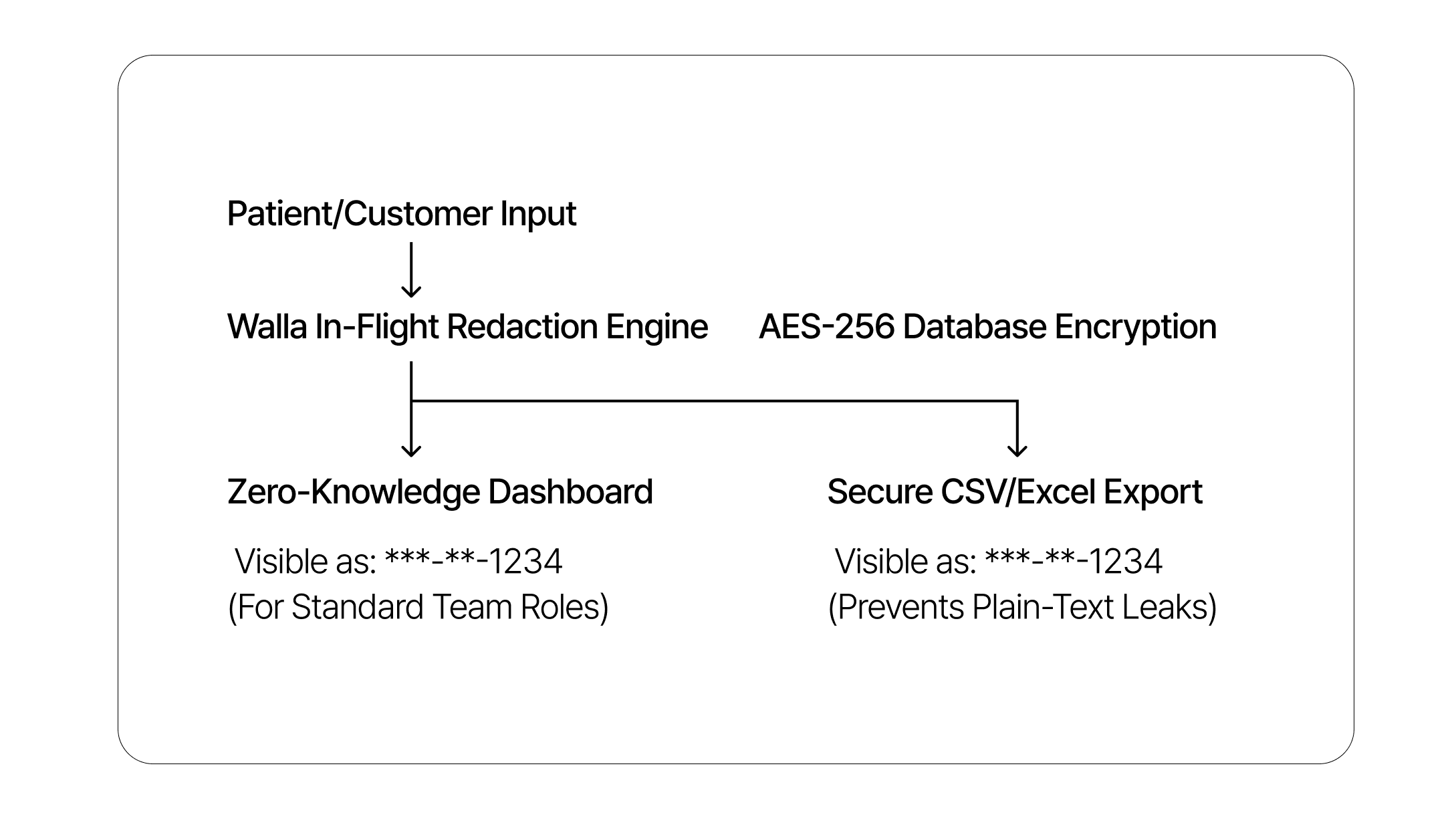
Here is a technical and logical breakdown of how Walla’s data masking engine completely eliminates the frontend privacy blind spot:
(1) In-Flight Redaction: Instant Ingestion Masking
Security shouldn’t wait for an administrator to run a manual script. With Walla, data protection happens in milliseconds.
How it works: When building your enterprise form, you can flag specific high-risk fields—such as Social Security Numbers (SSNs), phone numbers, dates of birth, or credit card identifiers—as "Sensitive PII."
The Result: The moment a user clicks "Submit," Walla’s in-flight redaction engine processes the string. While the unmasked data is safely encrypted and sent to your secure server, the dashboard preview string is instantly transformed into a safe, masked format (e.g., converting a raw number into
**--1234).
(2) The Zero-Knowledge Dashboard: Rendering Leaks Worthless
A classic insider threat or accidental leak involves malicious or careless screen-capturing. If an employee's account is compromised, a hacker can easily scrape hundreds of records right off the web page.
How it works: Walla operates on a Zero-Knowledge UI philosophy for standard team members. Unless a user possesses explicit, high-level administrative clearance, the plain-text PII simply does not load on their browser.
The Result: Support agents, marketers, and project managers can see that a form was submitted, read the benign feedback, and track submission trends, but they can only see the redacted versions of core personal identifiers. If an employee accidentally shares their screen on a video call or a bad actor compromises a standard staff account, the information value of the screen is precisely zero.
(3) Secure Exports: Ending the "Unsecured Excel" Nightmare
Ask any Chief Information Security Officer (CISO) what keeps them up at night, and they will tell you it’s local spreadsheets. Employees love exporting form data to CSV or Excel files to run pivot tables, filter lists, or share quick updates with other departments. Once a raw CSV file is downloaded to a local desktop, your corporate cloud security boundaries vanish.
How it works: Walla extends its data masking rules directly into your data export pipeline. When a standard user clicks the "Export" button, Walla generates a file where the sensitive PII fields remain strictly masked.
The Result: The downloaded Excel file contains
**--1234instead of the actual sensitive digits. Your teams can still run analytics, sort responses, and review user feedback on their local machines, but the risk of an unencrypted, plain-text PII spreadsheet circulating on local hard drives or unsecured corporate networks is completely neutralized.
4. 3 Real-World Enterprise Scenarios Where Walla’s Masking Saves the Day
To appreciate the value of UI-level visibility control, it helps to look beyond compliance theory and look at daily enterprise operations. Security breaches rarely happen in a vacuum; they happen during rapid scaling, tight deadlines, and routine team collaborations.
Here are three common, high-stakes business scenarios where standard form builders fail, but Walla’s automated data masking prevents a corporate crisis.
Scenario A: Managing Large-Scale, Remote Customer Support Centers
Your enterprise runs a global customer support operation with hundreds of remote agents and third-party contractors handling thousands of customer intake forms daily.
The Vulnerability: To solve user issues, agents must review form submissions where customers describe account problems. However, customers frequently paste sensitive account numbers, tax IDs, or birthdates into these forms. If hundreds of external contractors can view this raw PII, your insider threat surface area is massive.
How Walla Saves the Day: Walla allows you to isolate field permissions perfectly. Your global support agents can read the customer's open text descriptions and names to resolve tickets efficiently, but sensitive identification fields automatically render as
**--****. The work gets done seamlessly, while your core compliance posture remains completely unbroken.
Scenario B: The Accidental Screen-Share Exposure (The Zoom & Teams Nightmare)
It’s a fast-paced Tuesday afternoon, and an operations manager is sharing their screen over Zoom or Microsoft Teams during a cross-departmental alignment meeting. To debug a workflow issue, they pull up the company’s form submission dashboard.
The Vulnerability: In a standard form builder, the manager’s screen instantly displays unredacted customer data to everyone on the call—including junior interns, external vendors, or unauthorized staff members. If the meeting is recorded and saved to a shared cloud drive, that sensitive PII is now permanently exposed.
How Walla Saves the Day: Because Walla’s data masking is baked directly into the default UI layer, the dashboard displays sanitized data by default. Even during a live, high-definition video broadcast or an unexpected screen-share, nothing but safe asterisks are shown over core identifiers. Potential data exposure is neutralized before it can even happen.
Scenario C: Disarming the Departing Employee (The Insider Theft Attempt)
An internal employee with standard system access decides to leave the company to join a direct competitor. On their final week, they decide to download a bulk export of all customer survey responses and intake forms, intending to take a valuable database of customer leads and personal profiles with them.
The Vulnerability: With a traditional form platform, clicking "Export to CSV" dumps an unencrypted, plain-text spreadsheet containing thousands of raw customer rows onto the employee's local desktop. The corporate data has left the perimeter.
How Walla Saves the Day: Walla’s bulk export pipeline strictly honors role-based access rules. When a standard or low-privilege employee attempts a bulk download, Walla automatically generates a file where the critical PII columns are completely replaced with asterisks. The employee can walk away with the file, but the leaked data is stripped of its information value—making it completely useless to a competitor.
5. Turning Security into ROI: Reducing the Blast Radius and Audit Friction
In the corporate world, cybersecurity investments are traditionally viewed as a cost center—an expensive insurance policy that leadership hopes they never have to use. However, advanced data protection mechanisms like frontend masking fundamentally shift this dynamic.
By implementing UI-level security, enterprises don't just protect data; they actively generate measurable Return on Investment (ROI) by mitigating catastrophic financial risks and dramatically shortening compliance cycles.
(1) Minimizing the "Blast Radius" of a Breach
In modern cybersecurity, the question isn't if an account will be compromised, but when. Phishing schemes, credential stuffing, and social engineering tactics are highly sophisticated. If a malicious actor successfully compromises a standard staff member's login credentials, the immediate priority of your security team is containing the Blast Radius—the total surface area of damage the attacker can inflict.
The Standard Scenario: In a traditional form ecosystem, a compromised staff account gives the hacker an open ticket to scrape, copy, or bulk-export thousands of rows of plain-text customer profiles, SSNs, and private data. A single compromised password triggers a multi-million dollar corporate disaster, mandatory data breach notifications, and severe legal liability.
The Walla Scenario: With Walla’s automated data masking active, the blast radius shrinks to virtually zero. Because the sensitive PII strings simply do not load onto the frontend UI or standard CSV downloads, the hacker logs into a Zero-Knowledge environment. They can click around the dashboard or download spreadsheets, but all they will see are columns of useless asterisks (
**--****).
The ROI Impact: Walla transforms what would have been a catastrophic, brand-destroying data breach costing millions of dollars in regulatory fines and legal remediation into a minor, isolated IT containment event with zero actual data exposure.
(2) Eliminating Audit Friction: Fast-Tracking SOC 2, ISO 27001, and GDPR
Preparing for independent security audits like SOC 2 Type II, ISO 27001, or rigorous GDPR/CCPA compliance reviews is notoriously exhausting. Compliance officers often spend hundreds of hours compiling documentation, taking screenshots, and proving to external auditors that their internal access controls are functional.
The most heavily scrutinized section of any security audit is always Access Control and Data Privacy. Auditors will grill your team on exactly how you enforce data minimization and prevent unauthorized employees from snooping on sensitive data.
The Ultimate Compliance Shortcut: When auditors ask how you protect sensitive user inputs at the presentation layer, Walla gives you a definitive, ironclad answer. By simply demonstrating, "We enforce native, automated data masking at both the UI dashboard level and the CSV export layer," you instantly satisfy the most complex data minimization requirements.
Instead of building complicated internal tools or drafting lengthy policy documents to prove your staff isn't mishandling data, Walla’s architecture provides the objective proof auditors want to see. This cuts weeks of back-and-forth friction out of the audit process, allowing your engineering and compliance teams to clear checks faster, secure certifications with ease, and get back to driving core business growth.
6. Aligning with Zero-Trust: Secure Your Forms from the Screen Down
In the modern enterprise landscape, the definition of true data security has fundamentally evolved. Perimeter defenses, firewalls, and database encryption are essential, but they only solve half of the equation. True data protection is just as much about controlling internal visibility as it is about blocking external intrusion.
As organizations firmly adopt the Zero-Trust architecture—the philosophy of "never trust, always verify"—security policies can no longer stop at the database layer. They must extend all the way to the frontend glass, protecting sensitive information right where your employees interact with it every single day.
By implementing automated, UI-level data masking, you remove human error from the privacy equation. You neutralize the risk of accidental screen-share leaks, disarm potential insider threats, and shrink your data breach blast radius to virtually zero—all while giving your operations and support teams the unredacted context they actually need to stay productive.
Don't let a casual customer survey or a routine intake form become the single weak link that exposes your company to regulatory penalties or failed vendor audits. It's time to gain total control over your data visibility.
Eliminate Your Enterprise Security Blind Spots Today
Join security-first enterprise brands, fast-growing tech companies, and compliance officers who trust Walla to protect their most sensitive data streams.