1. The Academic Data Collection Dilemma
In modern academic research, methodologies have shifted heavily toward large-scale online sampling and complex longitudinal studies. While these digital approaches allow researchers to gather broader datasets across diverse demographics, they also increase the volume of data that must be managed and heighten the security responsibilities placed on research institutions.
The Dual Constraints of Academic Research
Researchers operating within universities and laboratory environments face two conflicting pressures when selecting data collection infrastructure:
Institutional Compliance and Data Governance: To protect human subjects and secure institutional approval, research designs must clear strict privacy benchmarks established by Institutional Review Boards (IRB). When surveys involve student populations, platforms must also comply with legal frameworks such as the Family Educational Rights and Privacy Act (FERPA), which mandates tight controls over student data and personal identifiers.
Budgetary and Fiscal Realities: Academic studies frequently require tens of thousands of individual responses to achieve statistical significance. However, most research labs operate under rigid grant allocations or limited departmental budgets, making long-term financial commitments to high-cost software suites impractical.
[ Strict IRB & FERPA Compliance ] ◄───[ The Researcher's Dilemma ]───► [ Limited Grant & Lab Budgets ]
Objective of this Guide
This analysis evaluates the structural gap between high-cost, specialized enterprise research software and free, basic form builders that lack necessary security controls.
The following sections examine how Walla serves as a balanced technical architecture for academic data collection. We will analyze its capability to support unlimited data ingestion to satisfy high sample size requirements while maintaining the backend data governance and privacy controls required for FERPA-compliant and IRB-approved research.
2. Constraints of Legacy Platforms in Academic Research
When designing an empirical study, researchers often find themselves forced to compromise between functional capability, fiscal viability, and regulatory compliance. The software market for data ingestion is polarized, leaving independent investigators and small laboratories to navigate structural limitations on multiple fronts.
(1) High Financial Barriers of Enterprise Research Software
Platforms like Qualtrics have long been recognized as standard tools for academic data collection due to their deep feature sets. However, accessing these enterprise-grade ecosystems presents significant financial hurdles:
Lack of Universal Access: Institutional or university-wide site licenses are not universally available across all departments, sub-branches, or smaller regional colleges.
Prohibitive Standalone Costs: For independent researchers, newly established laboratories, or cross-disciplinary grant teams lacking institutional coverage, the annual out-of-pocket subscription fees for enterprise tiers are often too high to fit within standard grant allocations.
(2) Functional and Security Deficiencies of Free Form Builders
On the other end of the spectrum, free utility tools such as Google Forms are accessible but fail to meet the rigorous design and security requirements of formal scientific inquiry:
Absence of Experimental Controls: Free platforms generally lack advanced logic engines. They do not support mandatory academic requirements like question block rotation, item randomization (to mitigate order bias), or multi-tier piped variables.
IRB Compliance Failures: These utilities typically offer limited control over data encryption routing and identifier isolation. Because they cannot enforce strict compliance parameters like FERPA, research proposals utilizing these basic tools face high rejection rates during Institutional Review Board (IRB) evaluations.
(3) The Response Cap Trap in General Commercial Tools
Many mid-tier commercial survey builders utilize pricing structures that conflict with the scaling requirements of large-scale sampling:

Data Capping: Lower-tier and mid-tier plans frequently place strict caps on monthly response volume, often cutting off ingestion after 100 to 500 submissions.
Pipeline Vulnerabilities: During large-scale cross-sectional studies, high-N panel investigations, or viral sampling initiatives, these limits can cause unexpected account suspensions. This leaves researchers facing a difficult choice: absorb unbudgeted overage fees or risk losing valuable, hard-to-replicate empirical data midway through data collection.
3. Understanding FERPA and Data Governance in Education
Data governance within educational institutions requires strict adherence to federal regulations and institutional guidelines. When research involves student populations, data collection methods must move beyond standard security protocols to ensure compliance with specific educational privacy laws and institutional oversight bodies.
The Core Mandates of FERPA
The Family Educational Rights and Privacy Act (FERPA) is a federal law designed to protect the privacy of student education records and Personally Identifiable Information (PII). Its regulations introduce specific constraints for academic surveys conducted within educational ecosystems:
Identifier Restrictions: FERPA strictly regulates the collection and maintenance of student tracking data without explicit, documented consent.
Third-Party Cloud Exposure: The law prohibits exposing student records or identifiable survey inputs to unverified third-party cloud infrastructures that lack certified educational data protection agreements.
Any platform used to collect data from students must provide the administrative and technical controls necessary to prevent unauthorized data exposure.
Essential Technical Conditions for IRB Approval
To secure approval from an Institutional Review Board (IRB), researchers must demonstrate that their data pipeline minimizes risks to human subjects. Two foundational architecture requirements must be met to clear this threshold:
(1) Strict Access Control (Principal Investigator Isolation)
The system must support granular access permissions. It must be technically possible to restrict raw dataset visibility exclusively to the Principal Investigator (PI) and designated co-investigators. Third-party platform administrators, university IT personnel, or general users must be structurally blocked from viewing unaggregated responses to prevent data leaks.
(2) Structural Data Segregation
The data collection environment must decouple research data from respondent identity markers.
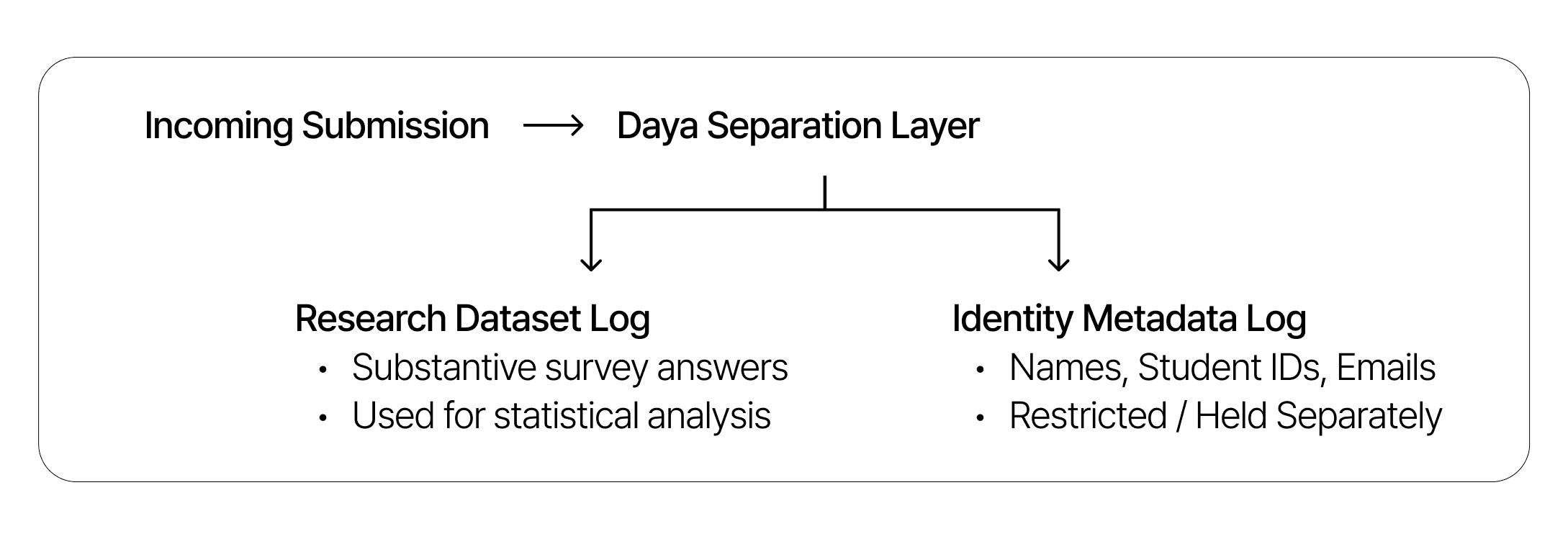
Substantive survey answers (the variables used for statistical analysis) must be stored separately from direct identifiers such as names, institutional student ID numbers, and email addresses. This separation ensures that even if a data breach occurs, individual survey responses cannot be easily linked back to a specific student.
4. Architectural Solutions for Researchers
Walla addresses the imbalances of the data collection market by providing an infrastructure designed to meet the scaling requirements, experimental validity standards, and quantitative workflows of academic research.
Unlimited Response Infrastructure Without Throughput Constraints
High-N data collection, multi-cohort cross-sectional studies, and longitudinal tracking require an infrastructure that scales linearly. Walla supports large-scale data ingestion by eliminating variable pricing models based on submission volume:
No Capacity Throttling: As sample sizes increase into the tens of thousands of rows, the platform maintains stable database writes without reducing ingestion throughput or bandwidth.
Predictable Cost Structures: By removing response-cap milestones and overage penalties, research labs can collect the exact sample size needed to ensure statistical power without risking sudden financial overruns.
Frontend Mechanisms for Research Validity
The validity of empirical research depends heavily on the design and execution of the data collection interface. Walla embeds structural controls directly into the frontend user layer to improve response quality and minimize statistical anomalies:
(1) Deterministic Skip Logic and Question Piping
To preserve experimental control, Walla provides conditional branching engines. Researchers can configure complex routing trees based on participant behavior:
Dynamic Question Adjustments: Subsequent item sets adapt dynamically based on previous responses, ensuring participants only interact with relevant experimental conditions.
Minimizing Survey Fatigue: This tailored path reduces cognitive fatigue, helping to lower drop-off rates and prevent mid-survey response bias.
(2) Structural Data Validation at the Ingestion Layer
To prevent dataset pollution from low-effort responses or automated bots, Walla applies strict validation parameters at the input interface:
Input Constraints: Open-ended fields can be restricted using character counts, input masks, or specific regex validations.
Filtering Incomplete Records: By verifying that text entries and numerical matrices conform to expected formats before submission, the system prevents random click patterns and empty values from generating statistical noise in the final database.
Downstream Statistical Software Compatibility
Data transformation and preprocessing can introduce formatting discrepancies and coding anomalies. Walla structures its database exports to ensure compatibility with standard academic data frames:
[ Walla Structured Database ] ──> Export Schema ──> Standardized Data Matrix (.csv / .xlsx) │ ┌───────────────────────────────┼───────────────────────────────┐ ▼ ▼ ▼ [ R / Python ] [ SPSS ] [ Stata ] (Clean Factor Encoding) (Precise Header Maps) (Uniform Vector Formats)
Standardized Schema Alignments: Outbound datasets are exported as cleanly structured matrices (
.csvor.xlsx) where variables, headers, and rows align perfectly with tabular formats.Error-Free Software Import: This structural consistency ensures that when files are read into statistical analysis environments like R (tidyverse), Python (Pandas), SPSS, or Stata, categorical variables and numerical indicators map correctly without generating missing-value errors or requiring extensive data cleaning.
5. Designing a FERPA-Compliant, Anonymous Research Pipeline
To meet the standards of university IRBs and federal data privacy laws, researchers must carefully configure their data tools from the moment a participant opens the survey to the final database storage. A FERPA-compliant pipeline requires a structured approach to blocking identifiers, obtaining consent, and securing data.
Step 1: Ingestion-Level Identification Blocking
True anonymity means preventing identifying metadata from ever reaching the survey platform's servers. True privacy cannot rely on simply deleting rows from a spreadsheet after data collection is complete.
Purging Network Footprints: When creating a survey, researchers can activate strict anonymity options within the settings panel. This setting instructs the system to block the collection of participant IP addresses, browser fingerprint configurations, and unique hardware identifiers.
Preventing Traceability: By stopping this tracking data at the perimeter, the platform ensures that response records cannot be linked to university network logs. This approach satisfies FERPA's strict requirements regarding student tracking and data exposure.
Step 2: Consent Matrix Integration
Before a participant can answer an experimental question, they must review and complete an Institutional Review Board (IRB) approved informed consent process.
[ Participant Opens Link ] ──> [ Informed Consent Page ] │ ┌────────────────────────┴────────────────────────┐ ▼ (Clicks "I Agree") ▼ (Clicks "I Do Not Agree") [ Main Experimental Form ] [ Session Immediately Terminated ] • Proceed to survey questions • Redirected to exit screen • Data collection active • Zero data written to database
The Informed Consent Gateway: The survey's opening screen must display the full IRB disclosure statement, including project details, risk assessments, confidentiality protocols, and principal investigator contact information.
Enforced Branching Logic: Researchers configure a mandatory selection component (e.g., "I have read the terms above and agree to participate"). If the user clicks "I Agree," Walla's logic engine opens the main survey questions. If the user clicks "I Do Not Agree," the pipeline terminates the session immediately, sending the user to a clean exit page without recording empty rows or partial entries in the master dataset.
Step 3: Secure Encryption and Storage
Once an eligible participant submits their responses, the data payload must be protected against unauthorized access and data corruption.
Data in Transit: When responses travel from the participant's browser to the research database, the entire payload is protected using industry-standard Transport Layer Security (TLS) encryption protocol, shielding the data from interception.
Data at Rest: Once stored in the database environment, records are secured using Advanced Encryption Standard (AES-256) encryption. This high standard of cryptographic protection provides university compliance officers and IT security auditors with a clear defense framework, ensuring that sensitive empirical data remains secure throughout the entire life cycle of the research project.
6. Conclusion: Optimizing Research ROI and Security
The validity and impact of empirical research are determined by balancing two factors: the quantity of data—ensuring a large enough sample size to achieve statistical power—and its quality, which depends on data security and methodological integrity.
Researchers no longer need to compromise on regulatory compliance because of budget constraints, nor should they reduce the scope of their investigations just to pass security audits. Selecting data collection infrastructure that offers both technical stability and a sustainable cost structure is a key strategic decision for modern academic research.
Platforms like Walla allow research laboratories and independent investigators to protect participant privacy, maintain strict FERPA and IRB compliance, and gather unlimited responses without financial volatility. By removing these operational bottlenecks, research teams can focus their resources entirely on generating valid, reproducible empirical discoveries.
Ready to Launch Your Academic Data Pipeline?
Secure your research data, satisfy institutional review boards, and scale your sample sizes without budget limitations.